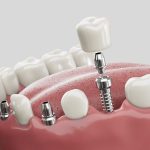



Before surgery, a CBCT 3D scan gives you a comprehensive three-dimensional picture of your sinus cavities, teeth, nerves, and jawbone. Your care team can use this cutting-edge imaging to precisely identify anatomical boundaries, measure bone density, and plan implant placement. This non-invasive scan helps ensure your dental implant procedure is safe, predictable, and tailored to your anatomy if you are considering dental implants in Vancouver. When planning a permanent tooth replacement, traditional two-dimensional X-rays only show part of the picture. A Cone Beam Computed Tomography (CBCT) scan captures cross-sectional views that reveal the depth, width, and overall quality of your bone tissue.
What Is a CBCT 3D Scan and How Does It Work?
A CBCT scan is a state-of-the-art imaging technology that uses a cone-shaped X-ray beam to take hundreds of individual images around your head in a single rotation. The system digitally assembles these images into a complete 3D model of your oral and facial structures.
A regular dental X-ray captures your anatomy and flattens it, showing only one plane. With 3D imaging, you can see your jawbone accurately from every direction. You stand or sit still for a few seconds; the machine spins around your head during the scan. The procedure is painless, quick, and uses far less radiation than a conventional medical CT scan.
Why Is a CBCT Scan Necessary for Implants?
Your dentist needs CBCT scans to get a clear 3D view of your jawbone density and map nearby nerves and blood vessels for dental implants. This detailed breakdown ahead of time helps prevent unforeseen complications and gives your new implant the best chance to bond securely.
If you are wondering if a CBCT scan is necessary for implants, consider how much detail is required to anchor a post securely in your jaw:
- Bone Density Assessment: It shows whether your jawbone is thick and dense enough to support an implant or whether you need bone grafting first.
- Nerve and Sinus Mapping: It helps avoid impingement by locating the inferior alveolar nerve in the lower jaw and the sinus cavities in the upper jaw.
- Pathology Detection: It can detect hidden infections, cysts, or structural abnormalities that traditional X-rays may miss.
- Precise Sizing: It lets your dental team choose the ideal height and diameter for your custom titanium implant post.
What Specific Features Does a 3D Scan Reveal?
A 3D dental scan before implants reveals bone height and width, soft tissue thickness, proximity to neighboring roots, and exact sinus boundaries. These spatial insights remove guessing from the restorative planning phase.
Here is a quick look at how traditional X-rays compare to a 3D CBCT scan:
| Imaging Feature | Standard 2D Dental X-Ray | 3D CBCT Scan |
| Dimensionality | Flat 2D height and width only | Complete 3D depth, height, and width |
| Bone Quality Assessment | Limited visual density details | Precise cross-sectional bone measurement |
| Anatomical Mapping | Overlapping structures can hide nerves | Clear isolation of nerve pathways and sinuses |
| Pre-Surgical Accuracy | General structural overview | Exact anatomical precision |
Receiving a comprehensive CBCT scan for dental implants gives your practitioner a complete blueprint of your mouth.
Partnering with a skilled Vancouver dentist ensures your restorative journey starts with accurate diagnostic data.
What Should Patients Expect During a Scan?
A CBCT scan is a swift, comfortable, non-invasive experience that requires no special preparation. The entire scanning procedure takes less than a minute.
Here is what happens during your appointment:
- Preparation: You will be asked to remove any metal objects, such as jewelry, hair clips, or eyeglasses, that might interfere with the X-ray images.
- Positioning: You will sit or stand comfortably while resting your chin on a small support platform to keep your head still.
- Scanning: The machine’s arm rotates 360 degrees around your head quietly, gathering high-resolution imagery in roughly 10 to 40 seconds.
- Review: The digital 3D model appears on the computer monitor almost instantly for immediate evaluation.
Schedule Your Dental Implant Consultation Today!
Accurate diagnosis and individualized treatment are the first steps toward a full, functional grin. Our hard-working staff at Unity Dental & Implant Center is committed to providing long-lasting oral health restoration. To arrange your consultation, contact Unity Dental & Implant Center today!
Frequently Asked Questions
Is a CBCT scan safe for dental implants?
Yes, a CBCT scan is safe and exposes you to a very low dose of radiation. The radiation level is significantly lower than that of traditional medical CT scans and is comparable to a few days of natural background radiation.
Does getting a CBCT scan hurt?
No, getting a CBCT scan is completely painless and non-invasive. You sit or stand still while the machine rotates around your head to capture images.
How long does a 3D dental scan take?
The scan itself takes only 10 to 40 seconds. Including setup and positioning, the entire appointment usually takes under ten minutes.
Can traditional X-rays be used instead of a CBCT scan for implants?
Traditional X-rays show only two dimensions and can’t precisely detect nerve depth or bone width, though they provide essential initial information. A 3D CBCT scan provides the spatial detail needed to guarantee safe installation.